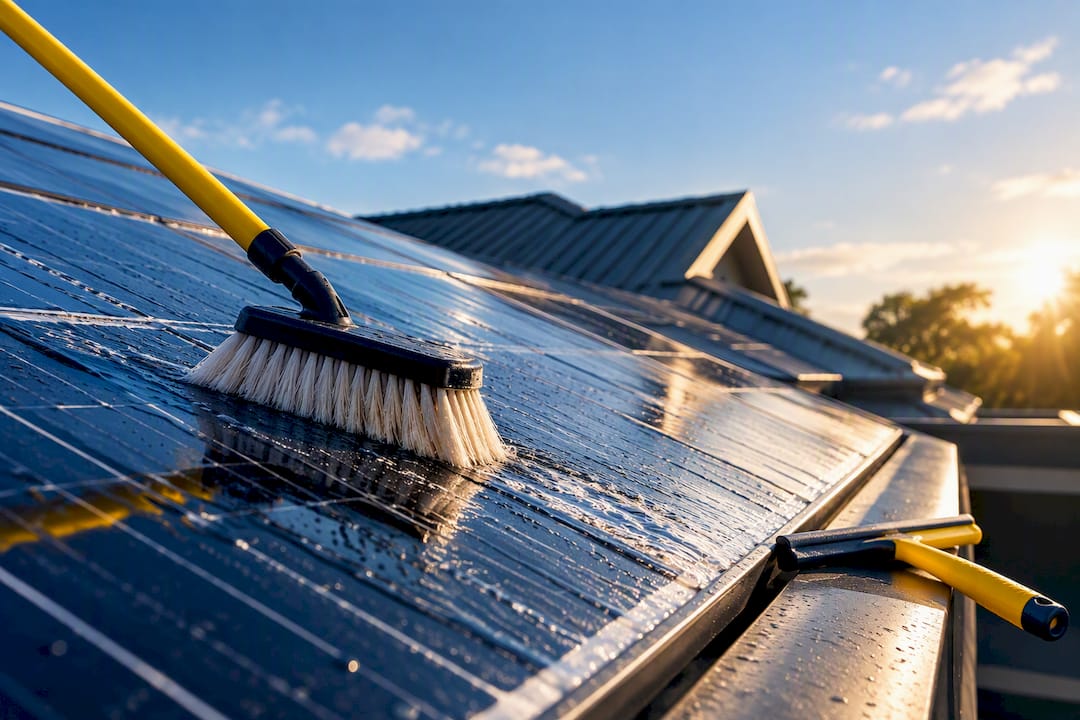
3 Safety Rules for Australian Homeowners Cleaning Solar Panels
3 Safety Rules for Australian Homeowners Cleaning Solar Panels
DIY cleaning is fine for single-storey homes with easy ground access, but steep roofs, second storeys or ageing systems call for a licensed professional. Three rules matter more than any other: shut the system down completely before you start, never climb onto the panels or work at height without fall protection, and never reach for a pressure washer or harsh chemicals. Get those three wrong and you risk either a serious fall or a cracked, warranty-voiding panel.
TL;DR:
- Only clean solar panels yourself if the system is on a ground-level, low-pitch roof and free of electrical damage or recent storm exposure.
- Always switch off the inverter and DC isolator before cleaning and avoid using pressure washers, abrasive tools, or harsh chemicals to prevent panel damage and warranty loss.
- Perform cleaning during early morning or evening when panels are cool, and use gentle rinsing, soft brushes, and pure water to minimize thermal stress and mineral spots.
- Avoid working at height without fall protection, never climb onto panels, and ensure a spotter is present if using a ladder for safer access.
- Schedule professional inspections at least every two years to detect hidden faults, loose hardware, or wiring issues that a visual clean alone may miss.
Table of Contents
- What is the correct solar panel cleaning safety checklist?
- Should I DIY this or hire a professional?
- How do you clean solar panels safely step by step?
- What tools and water are safe for cleaning solar panels?
- What are the biggest hazards when cleaning solar panels?
- What should be on your annual solar panel inspection checklist?
- Why does Aspect Window Cleaning weigh in on this?
- Ready to book a safer solar panel clean?
- Where can you check the official guidance yourself?
- Sources
- FAQ
What is the correct solar panel cleaning safety checklist?
Before you touch a hose or a brush, run through this sequence. It’s the same order our technicians follow on every job, whether it’s a single roof or a small commercial array.
- Shut the system down first. Switch off the inverter, then the DC isolator, and wait a few minutes before confirming through your monitoring app or panel indicator lights that the system is genuinely offline.
- Gear up properly. Non-slip footwear, insulated gloves, eye protection, and sun protection if you’re working through the middle of the day.
- Work from the ground wherever possible. A spotter is mandatory if a ladder is unavoidable, and no one should be on the roof alone.
- Check the water and the weather. Clean early morning or evening when panels are cool, never in direct midday heat.
- Know your stop signs. Visible cracks, a damp or discoloured junction box, a nest in the mounting rails, or a burning smell mean you stop immediately and call a technician.
The reason cleaning matters at all is efficiency. Soiling can cut annual energy output by 5% to 25%, with the worst losses in dusty, low-rainfall areas where dust settles for months between storms.
Should I DIY this or hire a professional?
Roof pitch and height decide most of the answer before you’ve even picked up a brush.
- Check your access. If the array sits on a single-storey roof with a shallow pitch and a solid anchor point for a ladder, a careful DIY clean is realistic. Anything steeper, higher, or without a safe standing point should go straight to a professional.
- Look for electrical red flags. Cracked glass, exposed wiring, or a system that’s been through a recent storm all raise the risk of shock during a wet clean, and none of that is worth troubleshooting yourself.
- Think about your warranty. Manufacturer guidelines specifically call out improper cleaning as a cause of voided cover, since pressure or contact damage can trace straight back to the person who cleaned it.
- Vet any contractor properly. Ask for proof of insurance, a police clearance, references from recent jobs, and confirmation they use a pure-water cleaning system rather than tap water and detergent.
Pro Tip: Get a written quote before the job starts, not a verbal estimate on the day. It should specify whether the system will be shut down for cleaning and what happens if damage is found mid-job.
Solar Victoria recommends professional servicing at least every two years by a licensed electrician regardless of how often you clean the panels yourself, since a visual clean and an electrical safety check are two different jobs.
How do you clean solar panels safely step by step?
Once you’ve decided DIY is the right call for your setup, the procedure itself isn’t complicated. It just needs to be followed in order.
Before you start:
- Check the forecast. Choose a still, overcast morning or early evening, never a windy, rainy, or scorching day.
- Arrange a spotter if a ladder is involved at all, even briefly.
- Gather your gear: hose, soft-bristle extension brush, squeegee, and water.
Shutdown sequence:
- Turn off the inverter first.
- Switch off the DC isolator next.
- Wait a few minutes, then confirm the system is offline through your monitoring app or the absence of indicator lights.
Cleaning sequence:
- Rinse the panels first with a low-pressure hose to loosen dust and loose debris.
- Working top to bottom, gently scrub with a soft brush on an extension pole. Never scrub a dry panel, since grit acts like sandpaper against the glass.
- Rinse again thoroughly, then squeegee or let the panels air dry.
- Avoid switching between hot and cold water on the same panel. A sudden temperature swing can stress the glass, the same way pouring boiling water into a cold glass can crack it.
After you finish:
- Do a visual check of the frames, seals, and junction boxes for any damage you might have caused or uncovered.
- Restart the system in reverse order: DC isolator on, then inverter on.
- Watch your monitoring app over the next hour to confirm output looks normal for the time of day.
This sequence mirrors what Popular Mechanics recommends for accessible ground-level or low-roof systems, and it’s the same order our crews use on residential jobs across Perth.
What tools and water are safe for cleaning solar panels?
Get this part wrong and you can damage a panel that survives a decade of Australian sun without a scratch.
- Safe kit: a garden hose on low pressure, a soft brush on an extension pole, a microfiber cloth, a squeegee, and a bucket of distilled or reverse-osmosis water if you have access to it.
- Water quality matters more than most people expect. Tap water leaves mineral spots as it dries; RO or deionised water dries clear. If you’re stuck with tap water, squeegee the surface before it air-dries to avoid the streaking.
- Keep temperature differences small. A gap of more than roughly 20°C between the water and the panel surface risks thermal shock to the glass.
- Never use a pressure washer, vinegar, ammonia-based cleaners, degreasers like Simple Green, abrasive scouring pads, or metal scrapers.
These aren’t arbitrary restrictions. First Solar’s module cleaning guidelines specifically flag high pressure and abrasive tools as causes of micro-cracks, seal failure, and delamination, all of which shorten a panel’s working life and can void the manufacturer’s warranty outright.
What are the biggest hazards when cleaning solar panels?
Four risks account for almost every solar cleaning incident, and each has a straightforward fix.
- Falls. Ladder work needs a spotter, a secure base on level ground, and three points of contact at all times. If you can’t get a genuinely stable footing, that’s your answer: don’t climb.
- Electrical shock. Panels generate electricity in daylight regardless of whether the inverter is switched off, and a cracked module or a wet junction box raises the risk of current tracking somewhere it shouldn’t.
- Panel damage. Standing on a panel creates a point load that can crack cells invisibly, and that hidden damage often shows up later as a hot spot and gradual output loss.
- Pests and debris. Bird nests and leaf litter in the mounting channels aren’t just messy, they’re a fire risk if they sit near junction boxes.
Pro Tip: If you find an active bird nest under a panel, leave it alone and call a professional. Disturbing nesting birds near live electrical components is one of the more avoidable ways a routine clean turns into an emergency.
What should be on your annual solar panel inspection checklist?
A clean without an inspection only tells you half the story. Pair the two every time you’re up there, or every time a professional is.
- Wiring and connections. Look for chewed, frayed, or discoloured cabling, and check junction boxes for moisture or corrosion.
- Inverter status. Persistent fault codes or error lights deserve a technician’s attention, not a reset and a hope.
- Mounting hardware. Check bolts for looseness and brackets for rust, especially after storm season.
- Documentation. Photograph anything unusual, save monitoring app screenshots showing abnormal output, and note the date. It gives a technician a head start.
If you spot exposed wiring, an arcing smell, or visible glass cracks, stop and call a licensed electrician. Confirm their credentials through EnergySafe Victoria’s guidance on home solar safety or by asking directly for proof of insurance and a current police check before they set foot on your roof.
Why does Aspect Window Cleaning weigh in on this?
Some professional crews handle solar panel washing as part of their residential and commercial cleaning services, alongside window cleaning, gutter maintenance, and high-pressure exterior work. That day-to-day exposure to roofs of every pitch and panel layout is where this checklist comes from.
A pure-water technology is often used to avoid the mineral spotting that tap water leaves behind, and professional jobs are usually insured.
— Team
Ready to book a safer solar panel clean?
If your roof is steep, your panels sit two storeys up, or you’re just not confident managing the shutdown sequence yourself, Aspect Window Cleaning is the safer alternative to a DIY attempt that risks a fall or a cracked panel. We use insured teams and pure-water cleaning systems, so you get a streak-free result without the mineral spotting tap water leaves behind and without anyone stepping onto your roof unsupervised.
Every professional clean includes a visual inspection of frames, junction boxes, and mounting hardware, so you get more than a wash. You get a record of the system’s condition. Solar Panel Cleaning is priced from $290 to $380 per job, and for larger solar farms it runs from $1.80 per panel. Check the full breakdown and request a free quote on our pricing page, or view our residential and commercial services if you’d rather bundle the clean with gutters or windows on the same visit.
Where can you check the official guidance yourself?
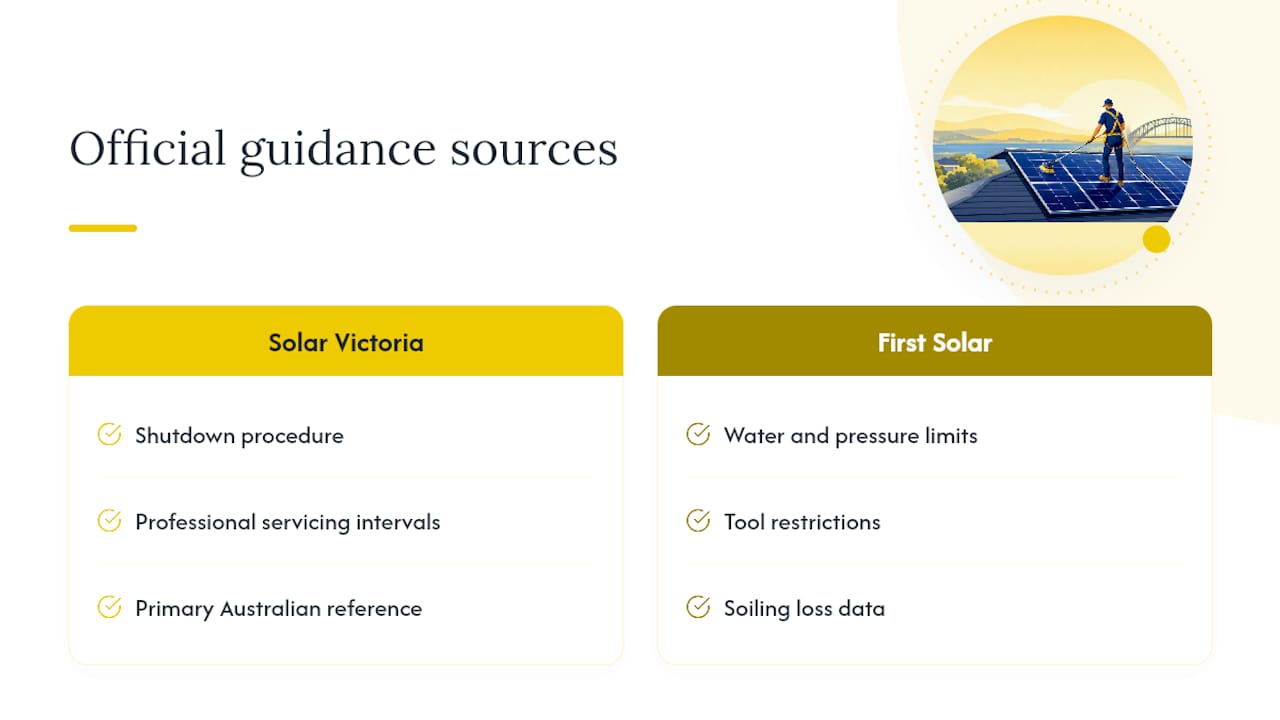
For the shutdown procedure and professional servicing intervals, Solar Victoria’s maintenance guide is the primary Australian reference. Manufacturer limits on water, pressure, and tools come from First Solar’s cleaning guidelines, and the soiling loss data underpins the cleaning frequency numbers above.
Sources
- Dust cycle and soiling issues affecting solar energy reductions in Australia using multiple datasets
- How to clean and maintain solar panels
- FS-Series PV Module Cleaning Guidelines
- How to clean solar panels
FAQ
Is it safe to clean your own solar panels?
It’s safe for most single-storey, ground-accessible systems if you shut the system down first and avoid climbing onto the panels. Steep roofs, cracked modules, or systems with recent storm damage should go to a licensed professional instead.
How do I safely clean my solar panels?
Shut down the inverter and DC isolator, confirm the system is offline, then rinse, gently scrub with a soft brush from a ground-based extension pole, rinse again, and squeegee dry. Clean early morning or evening when panels are cool, and never use a pressure washer.
How often do solar panels need to be cleaned?
There’s no single fixed interval, since it depends on local dust and rainfall, but properties in dry, dusty regions need cleaning more often than those with regular rain. Dirty panels can lose 5% to 25% of their annual output, which is the main reason to keep on top of it rather than waiting for a visible layer of grime.
What should you not clean solar panels with?
Skip pressure washers, vinegar, ammonia-based cleaners, degreasers, abrasive pads, and metal scrapers. Each of these can scratch the glass, strip protective coatings, or stress the panel enough to void its warranty.
Looking for Professional Window Cleaning in Perth?
Whether you need residential glass cleaned to perfection or commercial high-reach washing, our police-cleared team delivers guaranteed streak-free results across all Perth suburbs.
Liked this article?
Get the same sparkling finish for your Perth property.